Panorama of Totnes with castle, Devon, England

Beyond Limits in Devon

We are supporting people in Devon with learning disabilities, mental health issues and other support needs. This page has details of Job Fairs and Try Before You Apply events in Devon. You’ll also find Beyond Limits News and Stories from Devon.

Contact Beyond Limits Devon

Link to the Beyond Limits Southwest contact page

Beyond Limits Southwest staff

Follow this link to view Southwest Service leader profiles.

Vacancies Beyond Limits Devon

Follow this link to view our vacancies

Photo of cookies

Cookies Policy

When you use our website you are agreeing to our use of cookies. We hope that you will continue to visit our website and if you have any questions please get in touch. Our cookies policy works with our Privacy Policy.

What are cookies?

Cookies are bits of code that are passed between your computer and our website.

Why do we use them?

We use cookies on this website to run a programme called google analytics. Google Analytics tells us which pages are the most popular, which ones are not and what people search for. It also tells us the number of visitors to a page. It doesn’t store information about individuals who visit our website.

We also use cookies in our Staff area to make sure only Staff can log in and view these pages. This keeps our company information secure.

Will you see my personal information?

No. Our website cookies do not store any information about you as an individual. We also never collect information to use for advertising.

Is there more information about cookies on the Beyond Limits website?

You can contact the office for more details about cookies on our website.

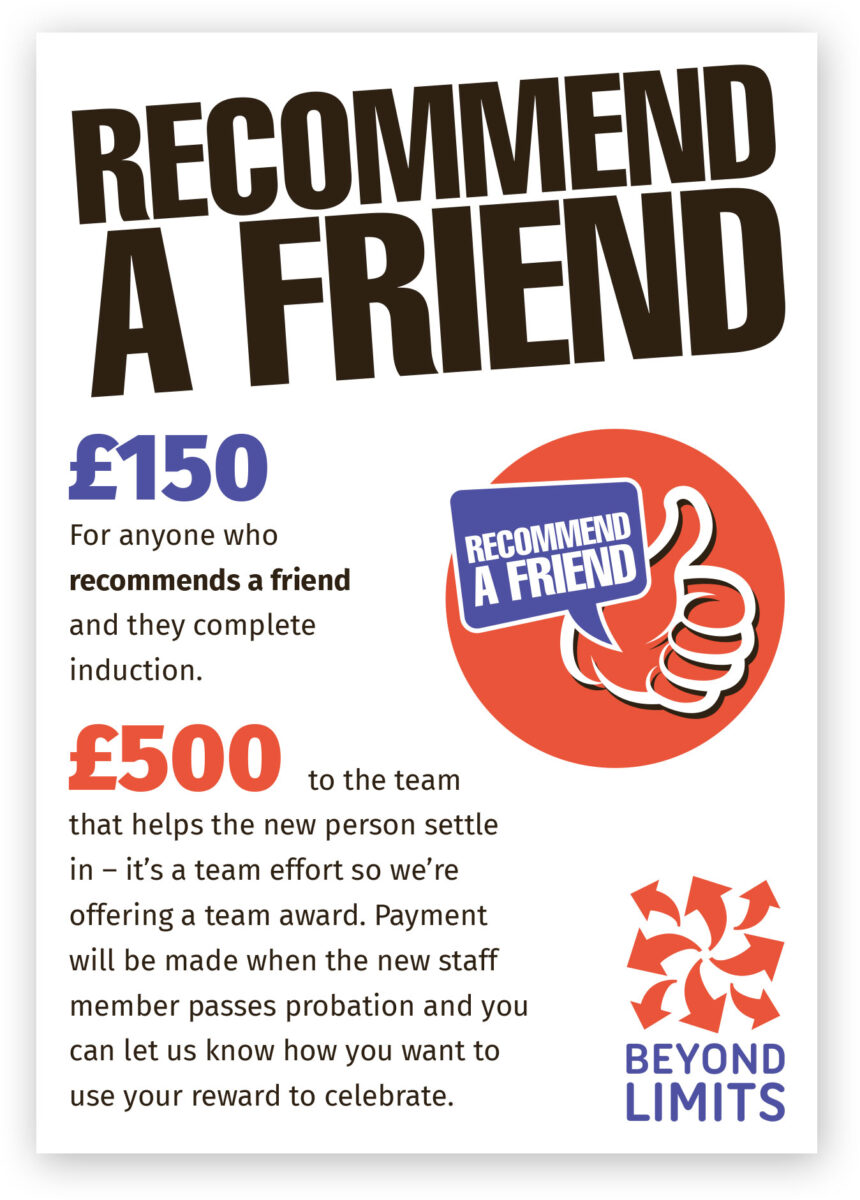
We’ve updated our Recommend a Friend scheme

Finding the right quality of care staff is a major challenge. It’s important that we don’t just fill the vacancies we have but that we fill them with the right people.

The right people are people like you, people who are already working here. That’s why we have launched our new and improved Recommend a Friend scheme because we know that you know the very next person you want to fill that vacancy in your team.

It’s why we are now offering bigger incentives than ever to make sure that we get the right people and you get the person you want. For each person that you recommend and that we hire, you will receive £150 once that person has completed their induction. We also know that sometimes having a new person join your team can be difficult and unsettling. Some of you might be asked to spend extra time with them showing them the ropes. We recognise it’s a team effort and so the biggest reward goes to the whole team. £500 will be paid when the person passes their probation and you can let us know how you want to use your reward to celebrate.


If you already have someone in mind please, get in touch.


Darren Simmons, a support worker at Beyond Limits

Life as a support worker

This article was written by Darren based on his experience of working as a support worker. Darren is currently working as a support worker for Beyond Limits.

How good are you at helping others?

If your friends are upset at stupid o clock in the morning, are you the first person they call? If you like helping others and love the thought of making a difference to a complete stranger’s life, then consider a career as a support worker.

What will you be doing?

The role of a support worker is exactly what it says on the tin. You provide support to individuals and their families who need help, both emotionally and practically, so they can live a happy, independent life.

The finer details…

A support worker role involves working with vulnerable people in different ways. You could be helping people who have mental health problems, learning difficulties, disabilities, recovering addicts, young offenders, those struggling with relationships… it could literally be anything.

No day will be the same. Some people may need emotional support to get them through a difficult time, while others will need a more hands-on approach. It’s your job to analyse their needs and help draw up a plan that’s unique to them.

The good points…

Put simply, you’ll make a genuine difference to people’s lives, which is guaranteed to make you feel all happy inside.

Nobody wants to be stuck in a dead-end job doing 9-5 until they retire, after all. Where’s the fun in that?

Working as a support worker gives you the opportunity to progress, from moving up the career ladder to earning more qualifications. If you get enough experience and study hard to earn a vocational qualification or a degree and you could move up to a senior or managerial role.

…and the bad

Your working hours are often split into shifts and on call hours to ensure there is all day support. This can include evenings and weekends, so there’s no time to be a lazy bones.

Is there study involved?

If grades were never your strong point at school, don’t stress, it won’t affect your chances of being a support worker. What matters most in this job is a passion for helping people and some life experience. Any past experience you have working in a health or support role is also good. You’ll need to show you can help people with a variety of issues and requirements, and that you’ll always remain supportive,

OK, I’m interested… But is it really the job for me?

This job involves helping others, not being judgemental about a situation, and providing support to change lives. It can be difficult so you’ll not only need skills but also patience, compassion and understanding. Basically, if you’re self-obsessed and don’t like dealing with people, this is not the job for you.

Ideal for those of you that don’t want to work a 9-5 repetitive job, some of the things you may be expected to do include:

Being a good listener – A good cup of tea and a hug can do wonders, but in this job you have to really listen, and listen well. One of the most important tasks is simply being there, and listening is a huge part of the job.

Doing chores – Sounds like a simple job but doing chores around the house can be a massive help. You could do cooking, cleaning, shopping as well as helping to pay bills.

Helping people live independently – Teaching life skills and helping people live an ordinary life will be one of your main goals as a support worker. From teaching people how to budget money and getting them involved with the community to getting them suitable housing that accommodates their needs, you’ll be there along the way to help with it all.

Family ties – You won’t just be helping vulnerable people, you’ll also be helping the people that can be forgotten; the families. Some may struggle with their relative’s issues, or they may just need a helping hand caring for them. Whatever their need, you’ll need to support them just as much.


If you are interested in working for Beyond Limits take a look at our current vacancies.


Keyboard showing a complaint key.

Complaints and feedback

Thank you for getting in touch with Beyond Limits.

We value all feedback and take complaints very seriously. We will try to resolve your complaint as quickly as possible.

Please give us as much detail as possible to help us resolve your complaint.
Please add your phone number if you would like us to telephone you.

Video – How Beyond Limits works

This page explains how our support works, about working for us and Consultancy for change.

Beyond Limits is a support provider that also uses its experience and knowledge to offer consultancy to others who wish to change services.

As a provider we support people with learning disabilities, mental health issues and other needs. We have a strong interest in helping people move back home from ‘out of area’ placements. We relish working with people labelled as challenging.

Get in touch…

If you’d like an informal chat about working for Beyond Limits or to receive our employment flyer by post, please get in touch using our contact form.

Photo of Susannah Caunter, a Beyond Limits Support Worker

Susannah’s “Reasons to become a support worker”

We were really pleased when Susannah Caunter, one of our support workers, sent us her 10 reasons to become a support worker. We hope you find them inspiring.

You’ll get a huge sense of job satisfaction

Being a Support worker is incredibly rewarding. For many, the relationships they form with the people they work with and the sense of personal achievement from helping them live their life to the full is the reason they get up in the morning.

You’ll make a difference

Being a care worker means making a difference. Making a difference to the lives of the people you provide care for and your community. Making a difference to yourself and leading a fuller, more compassionate life.

What You Do Really Does Count

Working for us is far more than just a job it gives you a sense of purpose as your work is important and you are valued by the people you support and their families.

No day is the same

Being a Support worker requires you to work in the home of the person you are supporting (not in a care home). Much of what a support worker does depends very much on the person you are supporting, its individualised. Not only could you be supporting them with their daily needs, you have the opportunity to support them to achieve any goals and ambitions they have and where possible we try to match people up if you have the same or similar interests…it makes it so much more fun!

It’s Fun!

This job is so much FUN! When working with a wide variety of people you’ll hear tons of interesting & heart wrenching stories.

The work is flexible

You can work the hours that suit you best. With full-time and part-time roles available, we can offer block hours or shifts depending on your availability.

You’ll have job security

With a demand for support workers that’s set to increase as Britain’s population ages, the social care sector offers good job security.

You’ll better yourself

As a support worker, you’ll learn a huge amount. Not just from the training but from the people you work with and the people you work for. Being a support worker is an eye-opening experience, and with the chance to work with people from all walks of life with varying needs of support.

Career path and progression

Social care is a rapidly growing sector, and the opportunities for career progression are varied. You’ll have the chance to build a career and by becoming a support worker that would be the first step to a rewarding career in social care. You’ll learn transferrable skills and gain training, and with ambition, you can go right to the top. With experience, you could take on more responsibility as a senior support worker or manager. You could also train as a social worker. With the right attitude and motivation, you can choose where to go next!

Why be a Support Worker

WHY NOT ???

Photo of small boats moored in Plymouth docks

Beyond Limits Plymouth

We are supporting people in Plymouth with learning disabilities, mental health issues and other support needs. This page has details of Job Fairs and Try Before You Apply events in Plymouth. You’ll also find Beyond Limits News and Stories from Plymouth.

Contact Beyond Limits Plymouth

Link to the Beyond Limits Southwest contact page

Beyond Limits Southwest staff

Follow this link to view Southwest Service leader profiles.

Vacancies Beyond Limits Plymouth

Follow this link to view our vacancies

Photo of a bridge crossing the river in Dumfries

Beyond Limits Dumfries & Galloway

Beyond Limits has been working in Dumfries & Galloway for several years. On this page you will find our contact details, policies and procedures information and staff profiles.

Beyond Limits Dumfries & Galloway website

Visit beyondlimits-dg.org

Contact Beyond Limits Dumfries & Galloway

Link to the Beyond Limits Dumfries & Galloway contact page

Dumfries & Galloway News and Stories

News and Stories on the Dumfries and Galloway website

Dumfries & Galloway staff

Staff profiles on the Dumfries & Galloway website

Dumfries & Galloway Vacancies

Follow this link to view our vacancies

Photo of Doreen Kelly and a person Beyond Limits supports. Fundraising coffee morning organised by Beyond Limits for an orphanage in Bangladesh Credit Paul Glendell / www.glendell.co.uk

An introduction to Beyond Limits

This section of our website tells you about Beyond Limits: our values, our history, how we are funded and who works for the organisation.

Beyond Limits started in 2011 to support people with learning disabilities, mental health issues and other support needs in Plymouth and throughout Devon.

We were set up with the support of Partners for Inclusion, a pioneering and award-winning personalised support organisation in Scotland. Our Director Doreen Kelly was the founder of Partners for Inclusion and its Director, then CEO, from 2000 to 2015.

Our mission is to change the face of services for good, and to provide tailored support to people who are vulnerable due to circumstance or disability, or at risk of exclusion.

Our main experience is in working with people leaving institutional care, such as hospitals, group residential care, special educational establishments and people said to have challenged conventional services.

Our aim is to provide truly tailor-made support, designed so that everyone we work with can have:

  • a home to call their own, which might be living with family
  • a real place in the community
  • control over their life and their future.

As well as providing services Beyond Limits is a catalyst for change. Through our consultancy for change we aim to work with others to transform the face of social care for good, starting in the South West.
Links


Link to our most recent CQC assessment page


Link to Beyond Limits Values page


working with families

Working with families

This page is dedicated to the families we work with, a place where we can share stories of hope and keep you informed of our developments.

Download the Charter

We are delighted to share with you our recently launched Family Charter, a series of statements which outlines our commitment to you and where we hope you will hold us to account.

Thank you for your involvement, we couldn’t do the job without you and thank you for being in the life of Beyond Limits and travelling the journey with us.


Download the Family Charter: Beyond-Limits-Charter-to-Families.pdf


How We Support People

How we support people

On this page we describe how we keep Beyond Limits support focused on the person we are supporting. How we don’t just talk the talk…

Everyone we support has:

  • their own budget for their support – usually in the form of an Individual Service Fund (ISF) – it’s not mixed in with other people’s money
  • tailor-made support – this means no two support services are the same
  • their own staff team – support staff matched to what they need and are interested in
  • their own home – which they can choose to share with someone else if they want.

Our support is based on careful and detailed individual planning. An overall Individual Service Design (ISD) sets out how we will support someone. A Working Policy (WP) sets out how to respond in difficult times when, for example, the person’s behaviour tells us we’ve got something wrong.

Word pattern graphic

The plan

The Individual Service Design is worked out in a person centred planning meeting with the person, people close to them and professionals. The person must agree who is at the meeting.

The Working Policy is developed mostly by speaking to people who have supported the person previously, finding out about all the issues and challenges the person has presented, reflecting on this and working out what worked and did not work in the past. This leads to a set of policies and staff guidelines that describe in detail how to support the person when things are not so good. All staff are required to work according to the WP, to ensure consistency of support.

Respect

By individualising the services we provide we are immediately treating people with respect and giving them control over how they live their lives. This in itself goes part way to reducing any so called challenging behavior. All behavior is communication, and challenging behaviour is a method people use to tell us they are not happy.

Beyond Limits won’t provide group or shared support unless people with learning difficulties or mental health issues ask for it. In practice this rarely happens. In our experience group services often cause ‘challenging behaviour’.

Louise in her new home sitting by the window.

Transforming Care: Louise’s Story

Louise’s Story is a video produced by NHS England as part of their Transforming Care series.

In the video you hear from Louise, and those who helped make her dream of moving home after spending over 15 years in hospital, a reality.

Louise’s story captures how hospitals are not homes, and Transforming Care is working to change the lives of people with learning disabilities, autism or both, for the better.

This short film explains how health and social care partners planned for and successfully moved Louise into her own home in spite of seemingly insurmountable barriers.

They achieved this through strong partnership working, good communication, flexibility and determination, and the film highlights the impact of these qualities on Louise’s wellbeing, while also celebrating the tenacity and creativity of those seeking to bring her home.

Beyond Limits purchased the property, but importantly, Louise’s tenancy is protected because the house was handed over to a housing association. This means that if Louise wants to change her support provider, she can do so and still remain in her home.

To find out more about the Transforming Care Programme visit NHS England’s website.

Beyond Limits founder

A short biography of Doreen Kelly, Director of Beyond Limits

Portrait photo of Doreen Kelly, CEO of Beyond Limits.

I started my career as a mental health nurse but soon moved to work in the voluntary sector, I have worked in the voluntary and independent sector since 1986 to help people become full and active citizens since. I have been involved in setting up several small, person centred organisations in both England and Scotland. These organisations were developed to support people to get a full life that makes sense for them and where they can be all they can be as opposed to institutional care and support which can often further damage vulnerable people.

I was the Chief Executive of Partners for Inclusion (www.partnersforinclusion.org) which we set up in 2000. Partners for Inclusion provides support that is tailor-made rather than trying to fit people into services that often don’t suit. The organisation was set up on the recognition that services were often mediocre and just good enough, but they did not put the focus on the individual. We wanted to do something different, to provide support that just wasn’t okay, but was first class. I left Partners for Inclusion in April 2015 to move to work at Beyond Limits full time.

I am the Director of Beyond Limits which is based in South West England. We support people who have labels of being challenging and complex to support. We work with people using a tailored approach and Individual Health Budgets (IHB’s) in the form of an Individual Service Fund (ISF).

An ISF is where the organisation, in this instance Beyond Limits, has the money paid directly to them but the money is ring-fenced for the person who gets support. The person and their family where appropriate and if they wish, are fully involved in how this money is spent. The money is used to get the person the life and support that they need or want. Beyond Limits supports people, who due to their perceived behaviour have been placed ‘out of area’ often far away from their homes, communities and families. We support people to come back home, take up their rightful place in their community by offering the tailored support that people need to do this successfully.

Doreen is also a board member of Manavodaya International UK as well as in Control Scotland.


Facebook | Linkedin


Doreen is a Fellows of the Centre for Welfare Reform and contributes to development and research with other Fellows to increase social justice, promote citizenship, strengthen families and enrich communities.

Dandelion with seeds blowing away in the wind across a clear blue sky

UK consultancy – helping others change

On this page Doreen Kelly, Director of Beyond Limits, talks about Beyond Limits consultancy services.

I have been working in health and social care services since the early 1980s.

In that time I have learned two important things:

  • tailor made is better than off the peg
  • stay small, emulate big.

Tailor made

Services only work properly when they are designed to ‘fit’ people, taking into account their needs as well as their hopes and ambitions for themselves. If you want to design a service that really works and is truly person centred, you have to learn about the person you are being asked to support. Find out from them and people close to them what they like, what they want to do with their lives, where they want to live, and then plan a service to respond to what they’ve told you. It’s like buying a suit or a dress.

Photo of Doreen Kelly, CEO Beyond Limits giving a presentation.

If you go to a tailor you can tell them what colours, style and fabric you like. They listen to what you want, take your measurements and make something that fits well, which you feel comfortable in, and which can, if you wish, last a lifetime. That’s the approach we take to service design. It’s better for the person supported, because they get what they want, and it makes sense financially because the chances of costly placement breakdowns are virtually eliminated.

Stay small, emulate big

In today’s competitive market providers have to find a way of staying small and responsive, while getting the economies of scale of bigger organisations.

Small organisations tend to be less procedure-bound, more flexible and more approachable. This is crucial in social care, because you have to be ready to change how you do things to meet the changing needs and demands of the people you support. Often if an organisation is unable to do this it leads to expensive placement breakdowns, which have both a financial cost and a potentially serious human cost.

Even so, bigger organisations have economies of scale, which can give them more influence and power. Our approach is to get the best of both worlds, by forming networks of small, person-centred organisations that can share functions like finance and HR support, and office premises. So we can stay small and emulate big.

We have lots of evidence that this approach works, both here in Devon and in Scotland. An example is the 2105 Award we received for our work with Plymouth Community Healthcare team.

If you are interested in the Beyond Limits approach I am available to talk with you about how you can make it real in your organisation. Please get in touch.

A bit of history

Beyond Limits provides personalised support. Personalised Support means we provide support to people with complex and challenging needs to live their own life, on their own terms.

Personalised support?

Partners for Inclusion logoPersonalised Support was developed in Scotland, in 1996, to provide support to people who were leaving institutions and moving into their own homes. It was and continues to be a radical step forward from the inflexible support often provided by Community Care services.

The first service to use this model was Inclusion Glasgow, followed by Partners for Inclusion, C-Change for Inclusion, Support for Ordinary Living (SOL) and other organisations who collaborate through the federation Altrum.

From Scotland to the South West…

Doreen Kelly, Director of Beyond Limits established Partners for Inclusion in Kilmarnock, Scotland, in 1996. For a detailed account of Partners’ work and history download Personalised Support, a book about Partners by Julia Fitzpatrick.


Download: Personalised Support 2012.pdf


Beyond Limits logo verticalPartners’ philosophy is to keep the organisation small. This ensures communication between those receiving support, friends, family and staff remains uncomplicated and efficient. When the number of people being supported by Partners got to 40, another organisation, Just Connections was established. This has been followed by other initiatives providing smaller amounts of support and the successful contact and dating project, DM2. Following this Beyond Limits was established.

Doreen set up Beyond Limits in 2011 and left Partners in April 2015 to focus on the work of Beyond Limits in the South West and England. Beyond Limits holds the same values and approach as Partners, providing truly personalised, innovative and creative support with the aim of helping all people leave institutions and enabling them to live full lives in their community.

Being a Support Worker “truly positive and life changing”

This article has been written by Louise Johns who has worked as a support worker for Beyond Limits for just over 3 years.

Before I became a support worker I was a full-time mum committed and dedicated to my family. Throughout the years being a mother, life has been difficult. Two of my children have learning disabilities as well as other medical issues.

As a mother I have had to fight for my daughters’ rights and support and help them to become the people they are today. I made my mind up that I wanted to become a support worker to help others achieve their goals and ambitions. My daughter had people with negative views telling her she wouldn’t be able to achieve the goals that she had set for herself.  I am proud to say my daughter has successfully reached her goal and is now working as a child care practitioner.

From my own life experiences, I found that I had a desire and determination to want to help others and Beyond Limits gave me that opportunity. They did not judge me; Beyond limits took a chance on me they gave me training and supported me throughout. It has been really lovely as I felt very at home. I came to realise that Beyond Limits is just one big happy family and I was delighted to be part of the team.

With Beyond Limits I have learnt so much

I have met new friends, and have a better understanding of everything.  Every day is very different as a support worker but extremely rewarding at the same time. Making such a significant difference to people’s lives is exceptionally important to me and I love supporting people to enable them to live independently. We support people to enjoy a very active social life and we all come together to discuss future plans, job & career opportunities for those people. It can be very exciting.

Beyond Limits give people great opportunities to progress, ensure that people have relevant training and development opportunities.

Being a support worker and supporting people to find their independence is by far the best job in the world. Seeing people’s faces light up when they talk to me about their day is the most meaningful part of the job for me.

Working with Beyond Limits has been truly positive and life changing.

By Louise Johns Support Worker